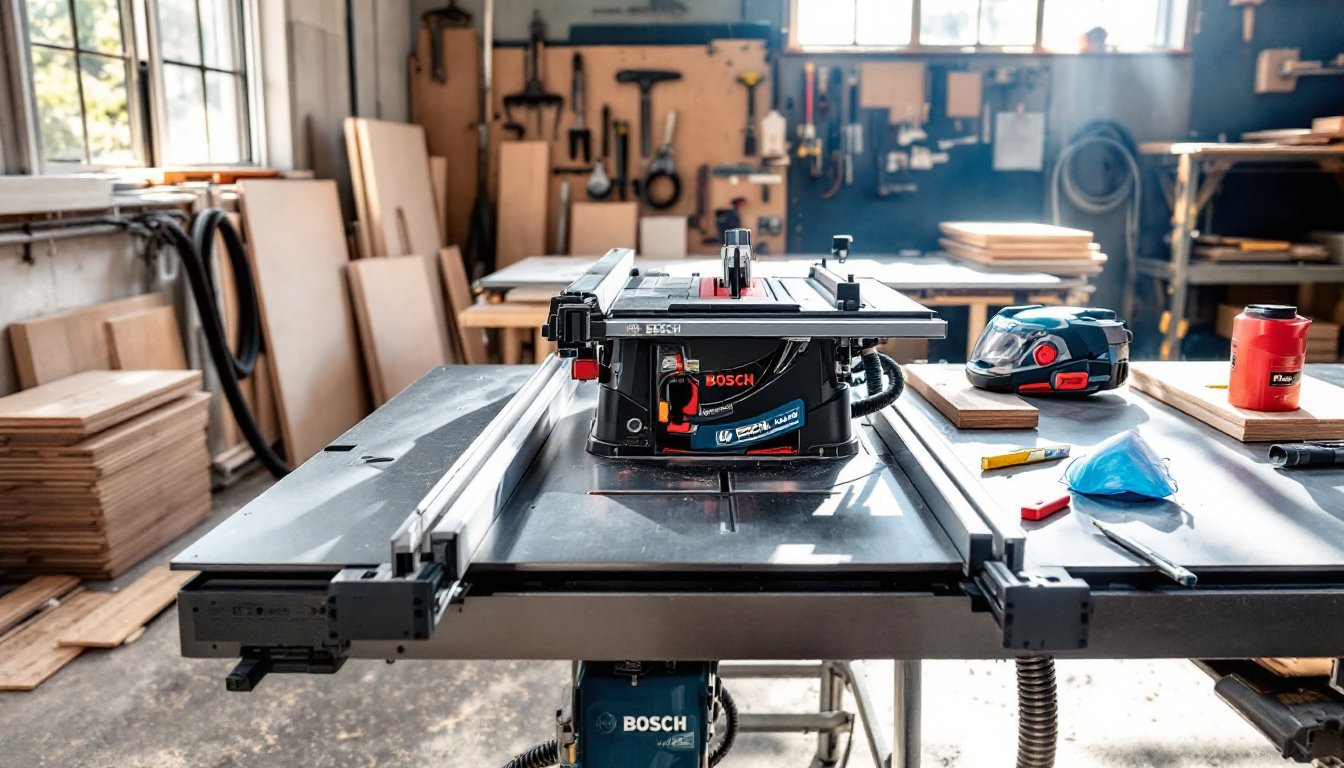
The Bosch 4100 table saw has earned a solid reputation among DIY enthusiasts and semi-professional woodworkers for combining portability with respectable cutting power. If you’re considering this saw for your workshop, whether you’re building decks, framing, or tackling cabinet work, it’s worth understanding what this machine actually delivers before dropping the cash. This guide walks through the key specs, real-world performance, and honest trade-offs so you can decide if the 4100 fits your needs or if a different tool makes more sense for your budget and projects.
Table of Contents
ToggleKey Takeaways
- The Bosch 4100 table saw combines portability, affordability, and solid 15-amp power for DIY framing, trim, and general woodworking without requiring a dedicated electrical circuit.
- With a 24.5-inch rip capacity, 10-inch carbide blade, and 4,800 RPM output, the Bosch 4100 handles 2x lumber and plywood smoothly but isn’t designed for heavy production or precision cabinet work.
- Setup takes only 20–30 minutes from the box, and at roughly 100 pounds, the saw is genuinely portable for jobsites and storage in tight shop spaces.
- The stock fence drifts under pressure during precision work; reinforcing it with magnetic locks or stop blocks is essential if you’re doing cabinet-grade or repetitive cuts.
- The integrated blade guard and splitter provide baseline safety, but always wear safety glasses, hearing protection, and a respirator—dust collection captures about 70–80% of particles at the port.
- The Bosch 4100 is ideal for weekend projects and occasional jobsite use, but serious production work or fine furniture building justifies investing in a larger, stationary cast-iron table saw.
Key Features and Specifications
The Bosch 4100-09 table saw ships with a 10-inch carbide blade and draws 15 amps at 120 volts, meaning it runs on standard household current, no dedicated circuit required (though a heavy-duty extension cord helps). The table measures roughly 27 inches wide by 40 inches deep, which is compact enough to fit a van or trailer but large enough to handle sheet goods with proper support.
The rip capacity (distance from blade to fence) maxes out around 24.5 inches, adequate for most trim, framing lumber, and plywood ripcuts. The blade tilts to 45 degrees, letting you cut bevels and miters without flipping material. One key spec to verify: this saw uses a 5/8-inch arbor, which fits standard blade options readily available at home centers.
Right out of the box, the saw includes a dust port, push stick, and rip fence. Accessories aren’t fancy, the fence is a simple aluminum rail system, but they’re functional and replaceable if you want to upgrade later (aftermarket fences exist if precision becomes critical for your work).
Performance and Power
At 15 amps, the 4100 isn’t a muscle machine, but it cuts steadily through 2x lumber, plywood, and hardwood at a reasonable pace. RPM tops out around 4,800, which is respectable for a portable saw and generates less tearout than older 3,450-rpm designs.
In practice, users report the saw handles rip cuts on 2×6 framing lumber without bogging down, though dense hardwood or thick stock may slow the blade noticeably. Crosscuts are smooth, the blade accelerates quickly without the hesitation you’d feel on underpowered tools. If you’re running it on a jobsite, check your breaker: plugging the 4100 into the same circuit as a miter saw or circular saw can trip 15-amp service under sustained load.
For cabinet-grade accuracy and speed, you’d want a bigger stationary saw (3–5 HP). But for framing, trim, and general shop work, the power output is fine. The motor runs cool, even during an afternoon of back-to-back cuts, which is a sign of solid engineering.
Portability and Setup
This is where the 4100 shines. Weighing around 100 pounds, it’s genuinely portable, two people can move it without strain, or one person can wheel it (if your cart handles the weight). The stamped-steel table keeps weight down compared to cast-iron alternatives, though it’s slightly less rigid in heavy production settings.
Setup from the box takes about 20–30 minutes: uncrate, attach the fence, plug in, check blade alignment, and cut. No motor assembly or wiring needed. The flip-up stand (sold separately or included in some bundles) lets you break it down and store it upright in a garage corner, crucial if shop space is tight.
One caveat: the fence doesn’t lock down with the mass of market-leading brands. On uneven surfaces or during aggressive rips, fine adjustments may drift. Many owners reinforce the fence system with a magnetic lock or glue-on stops to hold position better. Out of the box, expect to check fence alignment every few cuts when doing precision work.
Accuracy and Precision
The Bosch 4100 is honest about its target market: it prioritizes durability and ease over the 0.001-inch repeatability you’d find in a cabinet saw. Rip fences hold ±1/16 inch or better under normal conditions, which is fine for framing, trim, and most DIY projects. For cabinet work or fine furniture, you’ll want to carry out your own stop blocks and fences to dial in repeated lengths.
Blade runout (wobble) is minimal out of the box, another strong point. The arbor is true, and there’s no annoying deflection when you push hardwood through. Miter gauge accuracy is standard: the slot fits a typical gauge snugly, and 90-degree crosscuts require a light hand and a sharp blade. Using a sharp, quality blade (not the OEM blade, which is adequate but dull fast) makes the biggest difference in cut quality.
If you’re ripping cabinet-grade veneered plywood or making tenon shoulders where tolerance matters, budget time for test cuts, micro-adjustments, and a sharp blade. The saw can do precise work, but you must earn it through setup and technique.
Safety Features and Dust Management
The Bosch 4100 includes a blade guard with splitter, a hood that sits above the blade, deflects debris upward, and prevents kickback. It’s straightforward but can be removed easily, which is sometimes tempting. Never run the saw without the guard, even for a “quick cut.” Most table saw injuries happen when someone bypasses safety features out of impatience.
The splitter (a thin blade-like extension behind the saw blade) helps prevent material from pinching and kicking back toward the operator. Unlike some aftermarket splitters, this one is integrated into the guard, so you don’t forget to install it.
Dust collection connects via a 4-inch port that works with a standard shop vac or dust collector. Suction is decent but not extreme: you’ll catch maybe 70–80% of dust at the port with proper setup. Many users add a secondary air baffle or miter gauge dust chute to improve capture. Running the saw without dust collection creates a lot of fine particles, wear a respirator rated N95 or better if you’re not venting to a collector.
PPE essentials: Safety glasses or face shield, hearing protection (the 4100 runs around 85–90 dB), and a dust mask or respirator. Tie back long sleeves and hair: never reach over or under the spinning blade.
Pros and Cons at a Glance
Pros:
- Runs on standard 120V household power (no rewiring required).
- Portable and genuinely movable by one or two people.
- Compact footprint fits tight shops and jobsites.
- Solid motor that doesn’t bog down on typical woodworking tasks.
- Integrated blade guard and splitter.
- Carbide blade included (performs better than old-school steel).
- Relatively affordable entry point for a motorized table saw.
Cons:
- Fence system needs reinforcement for precision work: stock fence drifts under pressure.
- 15-amp motor limits capacity on dense hardwood or thick stock: slower on heavy-duty production.
- Stamped-steel table isn’t as flat or rigid as cast-iron alternatives over years of use.
- Dust collection is adequate, not exceptional: secondary venting helps.
- Blade runout and setup require more attention than premium saws.
- Miter gauge is basic: many DIYers upgrade or build a crosscut sled.
Bottom line: The 4100 is a practical, no-nonsense saw for DIY framing, trim, and general shop work. It’s not a precision instrument, but it won’t leave you frustrated either. If you do repetitive production work, cabinet-grade cuts, or run the saw 8 hours daily, a heavier, stationary saw pays for itself in efficiency and accuracy. For weekend projects and occasional jobsite use, the 4100 delivers value without needless complexity.